
Giotto Returns to the Bardi Chapel: Restoration of the Stories of Saint Francis Completed
After four years of study and conservation work, Giotto’s cycle is once again fully visible. The restoration brings new clarity to the paintings and offers a deeper understanding of Giotto’s extraordinary figurative and spatial invention.
After four years of intensive work, the restoration of the Stories of Saint Francis in the Bardi Chapel at Santa Croce has been completed. The cycle is one of the masterpieces of Giotto’s mature period and a fundamental reference point for the development of fourteenth-century painting.
The extensive programme of study and conservation, promoted by the Opera di Santa Croce and designed and carried out by the Opificio delle Pietre Dure, now returns to visitors from around the world a masterpiece profoundly marked by a complex conservation history. The project was supported, alongside the Italian Ministry of Culture, by Fondazione CR Firenze, ARPAI, and a group of private donors, including Veronica and Dominique Marzotto and William von Mueffling. The Giving4Giotto campaign accompanied the project, engaging supporters from around the world in making the restoration possible.

Francis through the eyes of Giotto
The completion of the restoration takes on particular significance in the year marking the 800th anniversary of the Transitus of Saint Francis of Assisi.
The six great scenes in the chapel, inspired by Bonaventure of Bagnoregio’s Legenda maior, depict some of the crucial episodes in the saint’s life: the Renunciation of Worldly Goods, the Confirmation of the Franciscan Rule, the Apparition at the Chapter of Arles, the Trial by Fire before the Sultan, the Death of Saint Francis, and the Apparition to Brother Augustine and Bishop Guido.
The restoration, however, allows us to go beyond the iconographic narrative and gain a deeper understanding of Giotto’s workshop. Technical and stylistic differences, now more clearly visible, confirm the presence of several painters working alongside the master and under his direction.
The Bardi Chapel thus emerges as a true laboratory of fourteenth-century painting: a place where Giotto’s visual language was developed by a team of artists and where solutions began to take shape that would influence subsequent generations. The techniques employed also reveal the master’s remarkable freedom: working on a fresco base, Giotto made extensive use of a secco techniques to broaden the range of pigments available, modulate chromatic and spatial effects, and manage the different stages of work more effectively.
Four years of research and conservation
Scientific investigation, conservation, research and documentation proceeded side by side throughout the four years of work.
The first part of the intervention focused on problems that were less immediately visible but potentially more dangerous to the preservation of the cycle. The most fragile areas were consolidated, from cracks in the walls to areas where plaster and paint layers were at risk of detachment. Deterioration processes such as the widespread presence of soluble salts were addressed, deposits and altered materials were removed, and numerous synthetic fills dating from the previous restoration were replaced with materials more compatible with the original plaster.
Particularly delicate was the work on the overall appearance of the paintings. Alongside the larger losses were around five thousand small areas of loss scattered across the entire surface, as well as numerous abrasions. Different methods of integration were adopted, seeking wherever possible to restore continuity to the figurative narrative without erasing the traces of the work’s complex conservation history.
That history has deliberately been kept visible: from the limewashing of the paintings in the early decades of the eighteenth century to their rediscovery in 1851 and restoration by Gaetano Bianchi, and finally the intervention carried out by Leonetto Tintori under the supervision of Superintendent Ugo Procacci between 1957 and 1959.

The Trial by Fire before the Sultan, detail
Giotto’s revolution in space
Above all, it is Giotto’s extraordinary spatial invention that now emerges with renewed force.
The scenes are connected by a monumental painted architecture that is superimposed upon the real architecture of the chapel, ideally transforming it into a kind of great ciborium. Within this illusionistic structure, the episodes unfold in spaces conceived as large open settings facing the viewer, in which architecture and figures are in constant dialogue. Even in scenes set outdoors, such as the Renunciation of Worldly Goods, architecture plays a decisive role.
The restoration has restored continuity and legibility to this complex spatial system through interventions that remain clearly recognisable. For the first time, moreover, the incisions and lines used to construct the architecture on the wall have been subjected to comprehensive digital mapping. This makes it possible to follow more closely the process through which Giotto designed a pictorial space remarkable for its precision and complexity, and to understand one of the central elements of the revolution he introduced into painting.
A new discovery on the vault
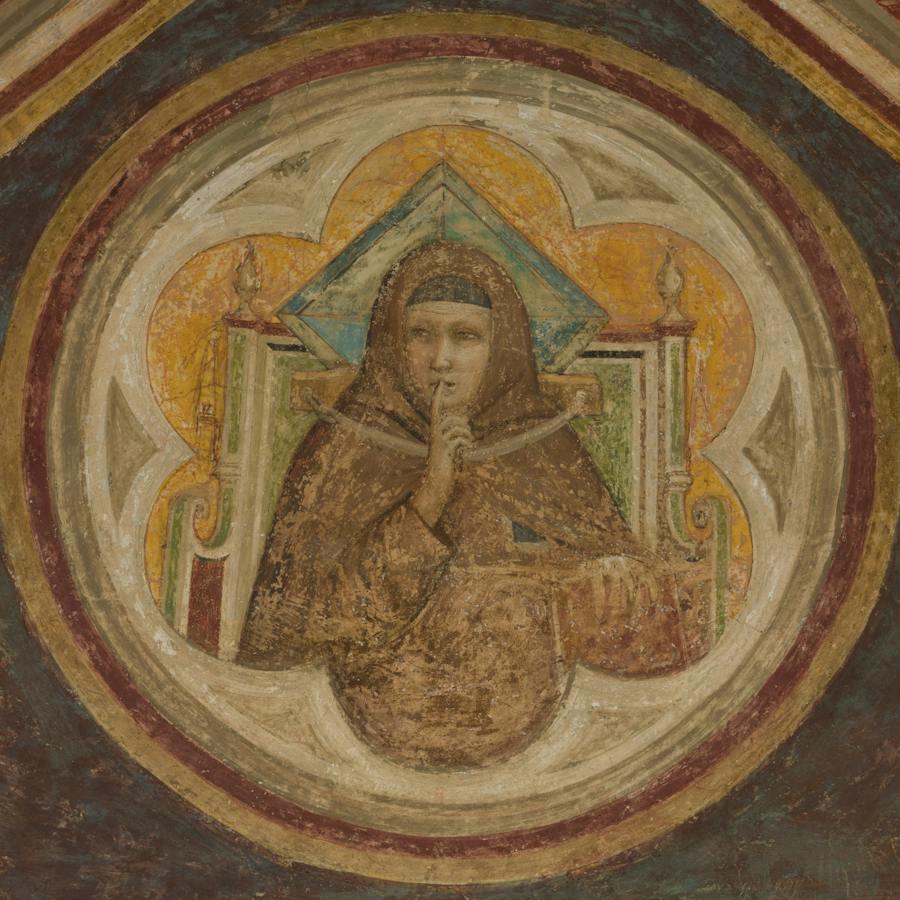
Among the most surprising results of the project is the chapel vault, an area that had received less attention during previous interventions.
Cleaning, carried out in this area partly with the aid of laser technology, has brought to light the remarkable figurative quality of the allegories of the Franciscan Virtues, particularly Obedience and Chastity, revealing details that until now had been difficult to read or had been misinterpreted.

A restoration looking to the future
The completion of the project is not simply the culmination of four years of work. The investigations and the vast amount of data collected provide a new body of knowledge from which further research into a crucial period of European art and culture can develop.
At the same time, the information acquired about the materials and their state of conservation will make it possible to monitor future deterioration and plan increasingly targeted conservation measures.
The completion of the restoration is therefore “not the closing of a chapter, but the prologue to stories yet to come.”
